
Checking Criminal History in Lenox
Lenox has no verified public police-record portal, arrest log, or municipal defendant search. The strongest path is a written request to the correct custodian, followed by county and state checks only when the record has moved beyond the city. Gather a date, location, report or citation number, name, and agency before starting.
- Confirm whether Lenox Police, Cook County sheriff, Georgia State Patrol, or another agency handled the incident.
- Submit a written Lenox request for a city-held report by hand, mail, email, fax, or letter to a city employee.
- Contact Lenox Municipal Court for a city citation, setting, or disposition.
- Check Cook County jail for a booking and Superior Court for a felony filing or final disposition.
- Use Georgia Felon Search or GCIC’s fingerprint-supported process for the appropriate statewide result.
Do not merge the answers. The report explains the event, the booking records intake, the court file shows prosecution, and GCIC compiles qualifying reported history. A blank result in one system does not erase records held in another.
Who Policed the Lenox Incident?
Location alone does not identify the record holder. A Lenox officer’s report belongs with Lenox Police Department. A sheriff’s report remains with Cook County. A Georgia State Patrol crash or enforcement report must be requested from the patrol. Ask which agency number appears on the citation, report receipt, or other paperwork.
This first identification prevents a request from circling between offices. It also matters when the city has no all-agency search. If Lenox says it did not create the record, ask whether staff can identify the responding agency. Then direct a focused request to that custodian rather than asking the city to reconstruct another agency’s work.
Lenox Police Department Records
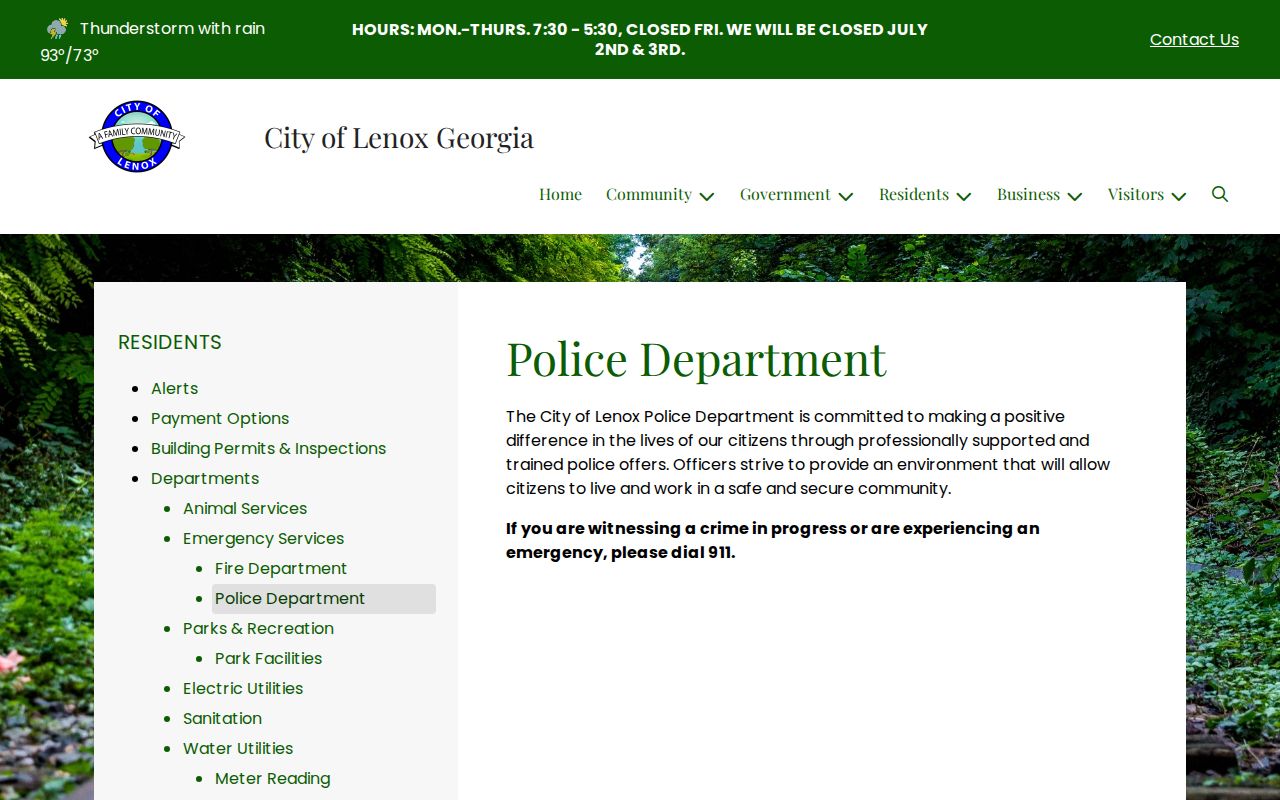
The official Lenox police page lists 229-546-3030. No direct public portal, app, arrest blotter, dedicated records form, fee schedule, or municipal case database was verified. Call to confirm the correct delivery address or records contact before sending sensitive identifying details.
Ask for an existing report by date, place, type, and number. The department may redact protected identifiers, juvenile material, confidential sources, active investigative information, or other exempt content. If a restriction applies only to part, ask whether the remainder can be produced. A police report documents an allegation and agency action; it is not a conviction.
The official Lenox Police Department page confirms the department’s mission and contact channel. The captured page is a starting point for an agency request, not a public name search.
Lenox Requires a Written Request
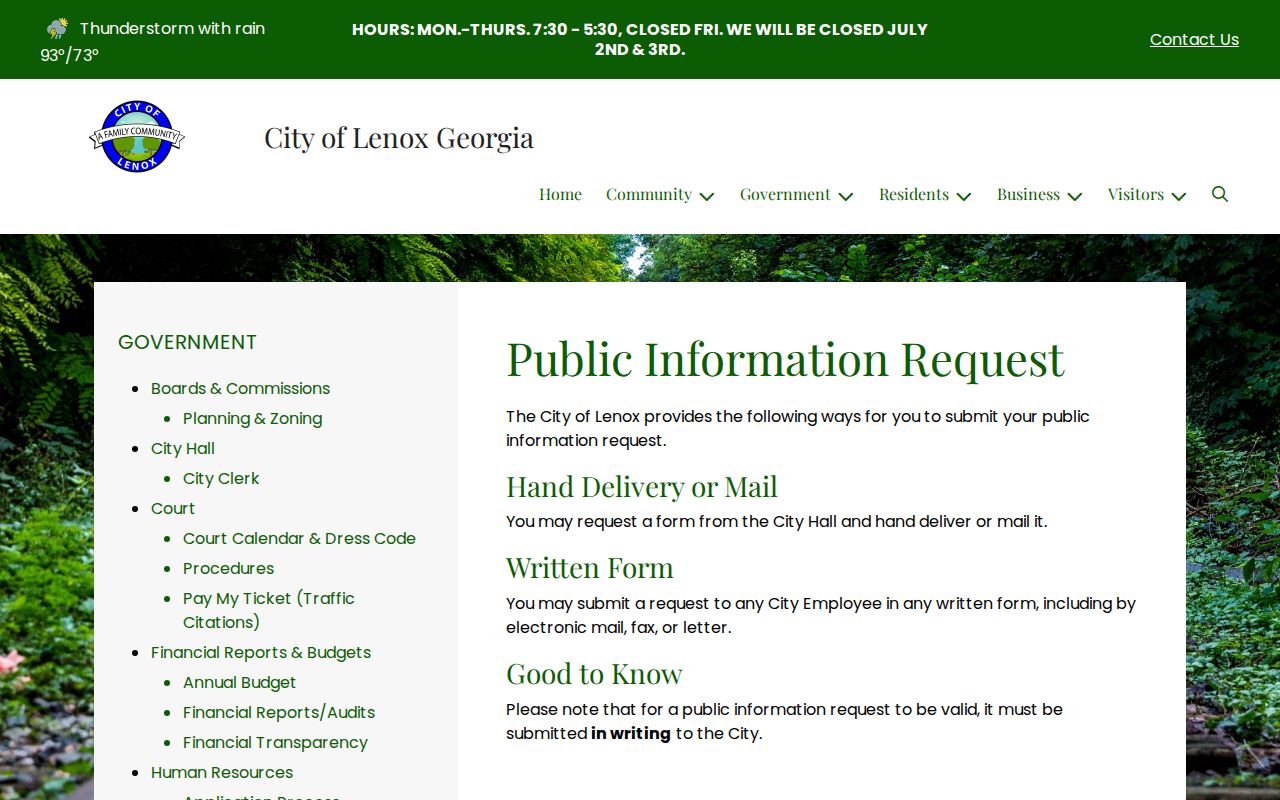
Lenox publishes the clearest small-city request fallback in Cook County. The city says a public-information request must be written. A requester can obtain a form at City Hall and deliver or mail it, or send a written email, fax, or letter to any city employee. This flexibility helps when no dedicated police web form exists.
Describe the particular record, date range, location, involved agency, and preferred format. Ask the employee to route it to the custodian if needed. No official online fields, request fee, identification rule, or precise local production time was published. Ask for a cost estimate before broad staff search or copying and retain a copy of the request.
The city’s official public-information request page documents these written channels. The captured instructions support a practical request without inventing a portal the city does not offer.
Lenox Arrests and Bookings
When a Lenox event results in custody, the handling agency creates the arrest report and Cook County jail can create a separate booking. Booking fields may include identifying data, intake charges, bond information, property data, photograph, and fingerprints. A citation that does not involve custody may never create a county booking.
Cook County has no verified public web jail roster. Contact the sheriff or jail for current custody and request a public booking record when needed. The current sheriff site lists 3335 County Farm Road, Adel, while an older county directory lists 1000 County Farm Road; verify before visiting. The Cook County arrest lookup gives the fuller county fallback.
When Georgia State Patrol Holds the Report
A state trooper’s activity within Lenox does not become a Lenox police record. Request the report through Georgia State Patrol using the incident details and patrol identifiers. The city may still hold a municipal or administrative record tied to the event, but it cannot supply a narrative created and retained by the state agency.
The same principle applies to sheriff activity. Search by author, not merely geography. A single episode can produce records at more than one level, yet each office answers only for the portion it owns.
Municipal Court Records in Lenox
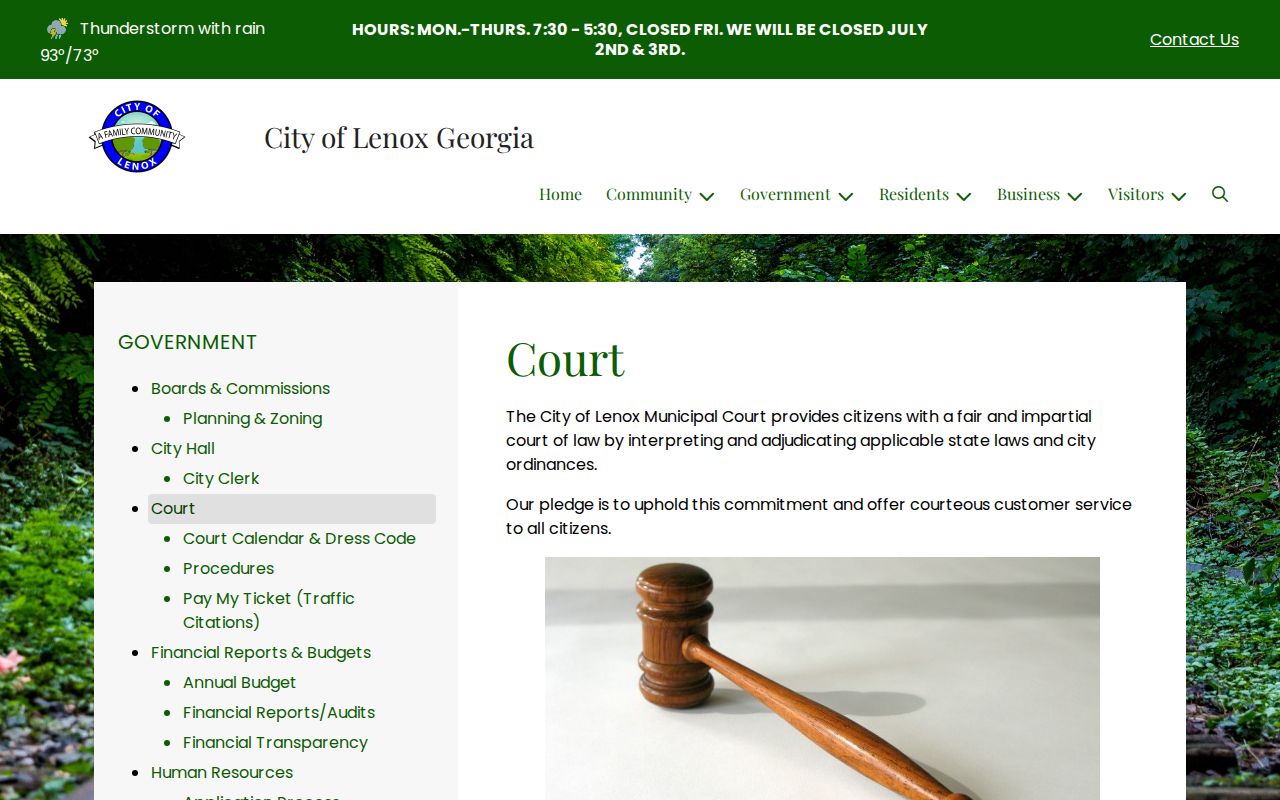
Lenox’s official court page says the municipal court adjudicates applicable state laws and city ordinances. Separate city pages address calendars, dress code, procedures, tickets, and payment options. None was verified as a public name-based docket search. Use the citation or case number and ask the court for status, disposition, or a copy.
| Court Name | Lenox Municipal Court |
|---|---|
| Case Types Heard | Applicable state-law matters and City of Lenox ordinance cases within municipal jurisdiction |
| Case Lookup Channel | Court or city contact; no verified public defendant-name database |
| What the Docket Shows | Citation or case identity, settings, court action, and disposition in the maintained public record |
| Copies & Fees | Confirm formats and current costs with the court; no official copy fee was verified |
The official Lenox court page establishes the court’s role. The captured information should be paired with direct clerk confirmation when a requester needs the actual docket or final order.
Lenox Municipal File or Superior Court?
A city ordinance citation stays at municipal level unless law and procedure send it elsewhere. A felony filing belongs in Cook Superior Court, part of the Alapaha Judicial Circuit. The initial booking charge can change after prosecutor review, so the court file is the stronger source for charges as filed and the final result.
The Cook Clerk of Superior Court is at 212 N. Hutchinson Avenue, Adel, 229-896-7717. Georgia Judicial Gateway is an access directory, not one complete statewide criminal database. PeachCourt requires an account and may not expose every older image. For a certified Lenox-origin felony disposition, request the file from the Cook clerk.
Where Lenox Records Go
A Lenox arrest can pass through several hands without becoming one consolidated file. The handling agency retains its narrative. The jail holds intake and custody data. The prosecutor selects the formal charge, the court keeps its docket and disposition, and qualifying information is sent to GCIC.
Record flow: Lenox handling agency › Cook County Courts › Georgia Bureau of Investigation, Georgia Crime Information Center
Recent activity is most likely to be confirmed by the handling agency or jail. Older prosecuted activity should be checked against the court result. If a GCIC history lacks or misstates the disposition, obtain the court record and use GBI’s challenge or correction route.
Three Agencies Can Touch One Lenox Case
Consider the record sequence, not just the person’s name. A trooper or Lenox officer can create the first report, Cook County can book the person, and the Superior Court clerk can maintain the prosecution. These documents can use different numbers and describe different stages.
Keep every report, booking, citation, and case number. When requesting a correction, state which field appears wrong and attach the authoritative disposition rather than asking one office to edit another’s record. This step-by-step method is slower than an aggregator search, but it preserves source and meaning.
Lenox Crime Counts Are Not County Rates
Use GBI Crime Statistics or FBI Crime Data Explorer with an exact Lenox reporting agency and year. County totals cannot be divided by Lenox population to invent a city rate. Such a calculation mixes jurisdictions and can hide reporting gaps or revisions.
Small-city percentages are also volatile. A change of a few incidents can create a dramatic percentage without showing a broad trend. Label the source, agency, year, and reporting limits. Crime statistics offer community context, not a personal criminal record.
Correcting a Lenox GCIC Cycle
Georgia’s GCIC system receives arrest and disposition data from criminal-justice agencies. GBI notes that a history can omit a final disposition or carry the wrong one. If the Lenox-origin cycle is wrong, identify the arrest date and charge, obtain the correct disposition from the court, and follow GCIC’s record-inspection and challenge instructions.
Georgia calls its relief process record restriction. For an arrest before July 1, 2013, the path generally begins with the arresting agency. For a later arrest, the prosecutor handles the restriction decision. Restriction limits dissemination and is not literal destruction. Court sealing may require a separate request, so retain all completion letters.
Public Access Rules in Lenox
The Georgia Open Records Act applies to existing city records, subject to lawful exemptions. It does not require Lenox to create a new criminal-history report, answer research questions, or produce another agency’s file. A response is generally due within three business days, though it may provide a production timetable rather than every record at once.
Key Statutes:
Georgia Open Records Act, O.C.G.A. §§ 50-18-70 through 50-18-77 - provides the request framework for existing public records and recognizes exemptions and redaction.
O.C.G.A. § 35-3-34 - governs dissemination of Georgia criminal-history information, including public felony-conviction access with required identifiers.
O.C.G.A. § 35-3-37 - establishes record restriction for eligible Georgia arrest cycles.
If Lenox withholds part of a record, ask for the cited exemption and any separable public portion. Juvenile, sealed, restricted, and active investigative material may have special limits. Verify the final result at the originating court before relying on it.