
Cook County Criminal Court Cases
Cook County Superior Court has general jurisdiction over felony prosecutions and sits in Georgia's Alapaha Judicial Circuit. Its clerk maintains indictments, accusations, docket entries, motions, judgments, sentences, and certified copies at 212 N. Hutchinson Avenue in Adel. The clerk's phone is 229-896-7717. A sheriff booking charge may change after prosecutor review, so the Cook County court file is the stronger source for the charge actually filed and its result.
Other Cook County courts hold narrower pieces. Magistrate Court issues many warrants and conducts preliminary or first-appearance functions. Probate Court handles Cook County traffic citations. Adel Municipal Court handles City of Adel citations and municipal matters. A search at one counter cannot rule out a record kept by another court.
Which Cook County Court Holds It?
The record's subject and procedural stage determine the right office. This Cook County court map prevents a common wrong-counter trip.
| Office | Record role | Contact |
|---|---|---|
| Superior Court Clerk | Felony filings, dockets, dispositions, sentences, certified copies | 212 N. Hutchinson Ave.; 229-896-7717 |
| Magistrate Court | Warrants and preliminary matters | 1000 County Farm Rd.; 229-896-3151 |
| Probate Court | Cook County traffic citations | 212 N. Hutchinson Ave.; 229-896-3941 |
| Adel Municipal Court | City ordinance and citation matters | Through Adel/APD, 204 E. Third St.; 229-896-4504 |
Searching Cook County Case Records
No complete anonymous Cook County criminal-case portal was verified. Start with the Superior Court clerk and provide the full name, an approximate arrest or filing year, and a case number if available. Ask whether the Cook County case is in the current electronic system, whether document images can be viewed remotely, and whether older material requires a counter search. Confirm plain-copy and certified-copy charges before ordering because the official sources reviewed do not publish those local fees.
| Search input | Why it helps | Known limit |
|---|---|---|
| Full legal name | Locates the party index | Similar names can collide |
| Case number | Strongest direct identifier | May be unknown at booking |
| Filing or arrest year | Narrows current and archived indexes | Filing may occur after arrest |
| Court and case type | Separates felony, warrant, traffic, and city files | No single court covers all matters |
PeachCourt Access for Cook County
The Georgia courts' e-access directory links Cook Superior Court with PeachCourt. The inspected PeachCourt page requires an account and advertises civil and criminal e-filing plus document service. Registration does not prove that every historic Cook County image is online, free, or open to anonymous review. Search fields, document prices, and result limits were not visible without entering the account system.
The official PeachCourt access page shows that account gate. The captured research image preserves the access screen rather than a private case.

A certified Cook County criminal file still comes from the clerk, even when electronic copies can help with initial review.
Inside a Cook County Case File
A Cook County case file builds a procedural history. Some identifiers and documents are redacted or withheld, so a public display is not a complete copy of every item held by the court.
| Case identity | Case number, court or division, filing date, case type, and status |
|---|---|
| Participants | Judge, prosecutor, defense counsel, and party style |
| Charges | Filed description, statute, class, accusation or indictment date |
| Docket events | Motions, notices, bond entries, warrants, hearings, and arraignment |
| Outcome | Plea, verdict, dismissal, no bill, nolle prosequi, or other disposition |
| Sentence | Custody, probation, fines, costs, restitution, and conditions when public |
| Documents | Downloadable images only when enabled and lawfully public |
Magistrate Warrants Before a Cook Felony
A Cook County felony trail can begin at Magistrate Court before any Superior Court case number exists. The local court issues many criminal and search warrants, conducts pre-warrant and bond hearings, handles written extradition waivers, and performs preliminary functions. Those records explain the early phase, but prosecutor review determines whether an accusation or indictment later appears in Superior Court.
The county's Magistrate Court page documents those duties. Its captured page gives local context without implying that warrant information is always public.
Sealed, unserved, juvenile, or investigative warrant material may not be available through an ordinary public request.
How a Criminal Case Moves
A Cook County criminal case changes as agencies make separate decisions. Intake allegations are followed by prosecutor review and court action, and charges may be amended, dismissed, no-billed, or placed on the dead docket.
Case flow: Charges Filed › Arraignment › Pretrial › Plea or Trial › Disposition › Sentencing
Custodial matters often include booking and first appearance before that six-stage court sequence. Appeals and supervision can follow sentencing. The final disposition should then be reported to the Georgia Bureau of Investigation's Georgia Crime Information Center, but reporting lag can make a GCIC history and Cook County docket disagree for a time.
Reading Cook County Dispositions
Read the disposition charge by charge. An indictment is a grand jury's true bill, while an accusation is a prosecutor's charging document. A dismissal ends a charge without conviction. A nolle prosequi means the prosecutor declined to continue it, and a no bill means the grand jury did not indict. A dead-docket entry postpones a charge indefinitely and does not automatically equal dismissal.
A plea or verdict answers guilt, while the sentence states the court-imposed result. Concurrent terms run together; consecutive terms run one after another. Georgia First Offender treatment has its own legal effect after successful completion and should not be paraphrased as an ordinary conviction without checking the actual Cook County order.
Certified Cook County Criminal Files
The Cook County Superior Court clerk is the authoritative source for a clerk-certified reproduction. Call 229-896-7717 before travel to confirm the current counter procedure, file location, image availability, and charge for plain or certified copies. Published county sources do not establish detailed lobby hours, parking rules, or copy fees, so those details should be confirmed rather than assumed.
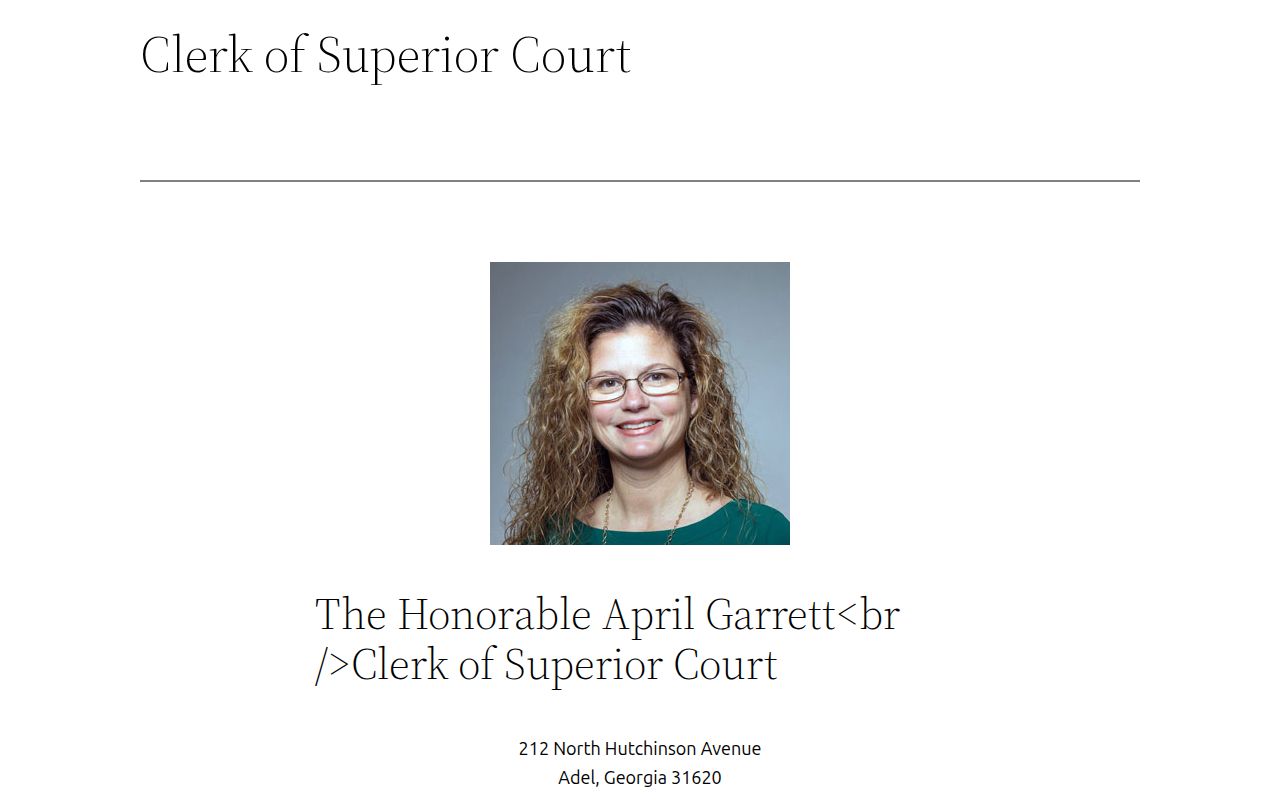
The official Cook County clerk page describes criminal filing, calendars, warrants, and record duties. The research capture shows the local office source used here.
The clerk can authenticate the court record, while the jail or arresting agency authenticates its own separate booking or incident record.
Case Record Access & Restrictions
Georgia court records are generally open unless a statute, court rule, or order protects them. Ordinary public views should not expose Social Security numbers, full birth dates, protected victim or minor information, sealed documents, or protected addresses. Juvenile matters are not treated as an adult public docket. Electronic access also does not turn confidential material into public material.
If a Cook County name produces no online result, ask the clerk about spelling, archived years, a different court, and non-digitized documents. Restriction of qualifying arrest information under O.C.G.A. § 35-3-37 and sealing of a courthouse file are distinct steps. A repository change does not itself prove that every court image was sealed. For the initial booking rather than the filed outcome, use the county's Cook County arrest lookup channels.
A narrow request is easier for the Cook County clerk to route than a demand for every criminal record tied to a name. Identify the court, year range, case number, desired docket entry or document, and whether a certified copy is needed. Ask for an electronic copy when the office can provide one, but remember that certification may require a clerk-issued form rather than a downloaded image. The Georgia Open Records Act does not override court rules, sealing orders, or specific confidentiality laws. If an office withholds or redacts material, ask which legal basis applies and whether a public docket entry or less restricted version remains available.
Missing final dispositions require a different response. Compare the Cook County court judgment with the GCIC history, then contact the court that owns the outcome so the correct disposition can be transmitted. The AOC Criminal Case Data Exchange dashboard tracks court-to-GCIC transmissions at a system level and refreshes periodically, but it is not a person search. That dashboard can explain the reporting process; it cannot replace a certified Cook County judgment or correct a private record by itself.
Note: A blank electronic search does not prove that no Cook County case exists or that every record has been cleared.